
Tubeless Tires and Sealant: Everything You Need to Know
Tubeless tires have become the standard for many cyclists, from road riders to mountain bikers. They offer clear advantages: fewer punctures, improved grip, and better rolling performance. But to fully benefit from a tubeless setup, one component is essential—sealant.
In this guide, we explain how tubeless systems work, why sealant is critical, and how to choose the right solution for your riding conditions.
Why Tubeless Tires Need Sealant
Unlike traditional inner tubes, tubeless tires rely on an airtight seal between the tire and rim. Small punctures, porous casings, or minor imperfections can cause air loss.
Sealant solves this by:
Instantly sealing small punctures while riding
Maintaining consistent air pressure
Extending the lifespan of your tires
Without sealant, a tubeless setup simply cannot function reliably.
The Reality of Tubeless Riding
While tubeless systems offer clear advantages, they also introduce complexity. Performance depends on multiple factors:
Temperature and seasons (cold, heat, humidity)
Tire construction and TPI (porosity varies)
Tire pressure (high-pressure road vs. low-pressure MTB)
Riding style and terrain (sharp rocks, debris, road conditions)
Type of puncture (small holes vs. larger cuts)
A sealant must perform consistently across all these variables to deliver real-world reliability.
What Makes a Good Sealant?
A high-quality sealant needs to strike a balance between several key characteristics:
Fast sealing performance to stop punctures immediately
Long active life to reduce maintenance frequency
Stability across temperatures for year-round use
Compatibility with CO₂ cartridges, inserts, and different tire types
Ease of use and cleaning for both riders and mechanics
Achieving this balance is what separates an average product from a reliable solution.
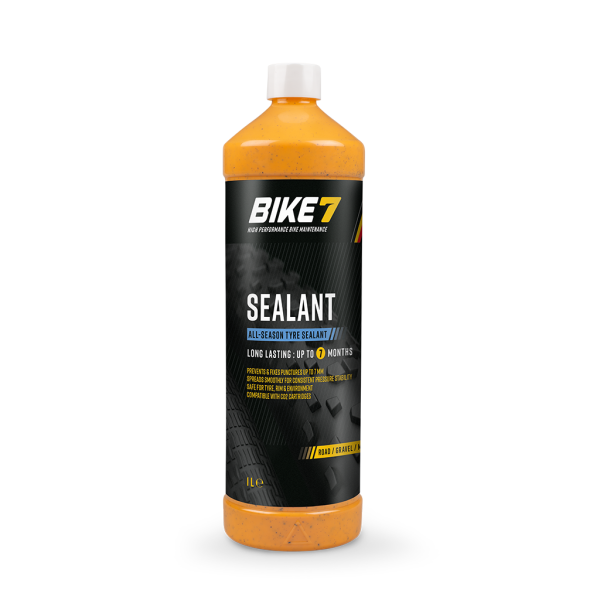
Bike7 Sealant: A No‑Nonsense Approach
Bike7 Sealant is developed with a clear philosophy: keep it simple, effective, and reliable in real-world conditions. The focus is not on complexity, but on delivering consistent performance where it matters most.
Key characteristics include:
Seals punctures up to 7 mm
6–10 months of active protection
Compatible with CO₂ cartridges
Safe for rims, inserts, and all tubeless tyres
Effective from –20°C to +50°C
Available in 150 ml, 1 L, and 5 L formats, it covers both individual riders and professional workshop use.
Why This Makes a Real Difference
Sealant needs to perform not just in ideal conditions, but in everyday riding scenarios. From freezing temperatures in winter to dry and dusty summer rides, consistency is key.
A formulation with a long active life means:
Less frequent top-ups
More predictable performance
Lower maintenance for riders and workshops
This translates into a smoother riding experience and greater confidence on every ride.
Tested in Real Conditions
Developing a reliable sealant requires more than lab testing. Considerable time has been invested in refining the formulation and validating performance through extensive testing—both at competitive level and in everyday riding conditions.
This ensures the product performs not just on paper, but where it truly matters: on the road and trail.
Visible and Easy to Clean
The distinctive orange color of Bike7 Sealant serves a practical purpose. It makes leaks immediately visible during installation and maintenance, allowing riders and mechanics to quickly identify punctures.
At the same time, the formula is designed to be:
Water-soluble
Easy to clean from frames and clothing
This minimizes mess and makes maintenance more user-friendly.
How Much Sealant Do You Need?
For optimal performance, using the correct amount is essential:
Tire type | Amount per tire |
Road (23–30 mm) | 60 ml |
Gravel (38–48 mm) | 80 ml |
MTB (29”, 2.0–2.4) | 120 ml |
Larger tires | 150 ml or more |
Pro tip: slightly increasing the amount improves protection, especially in rough conditions.)
Application Made Simple
Shake the bottle well before use
Add sealant directly into the tire or through the valve (core removed)
Inflate and rotate the wheel to distribute evenly
Regular checks—especially in hot conditions—help maintain optimal performance.
Conclusion
Tubeless technology offers clear advantages, but only when supported by the right sealant. By focusing on reliability, ease of use, and long-lasting performance, Bike7 Sealant provides a solution that meets the demands of modern cyclists—without unnecessary complexity.
Featured products